
TL;DR:Morning affirmations can reprogram negative thought patterns by focusing the mind on positive beliefs. Repeating short, believable lines each day helps build mental resilience and confidence. Consistent practice paired with daily routines strengthens the effects, making a small, deliberate effort highly effective.
Say these five lines out loud right now, standing tall with your shoulders back:
- “I am capable of handling whatever today brings.”
- “I choose to see the good in myself and others.”
- “I am worthy of good things.”
- “Today I show up fully.”
- “I am getting stronger every day.”
Say each one slowly, once, right after you wake up. That’s the whole instruction. Research on neuroplasticity and negativity bias shows that repeatedly directing your attention toward positive outcomes can shift habitual thought patterns over time, which is exactly why a few deliberate words at the start of the day carry more weight than they might seem.
Table of Contents
- 1. Morning affirmations organized by goal
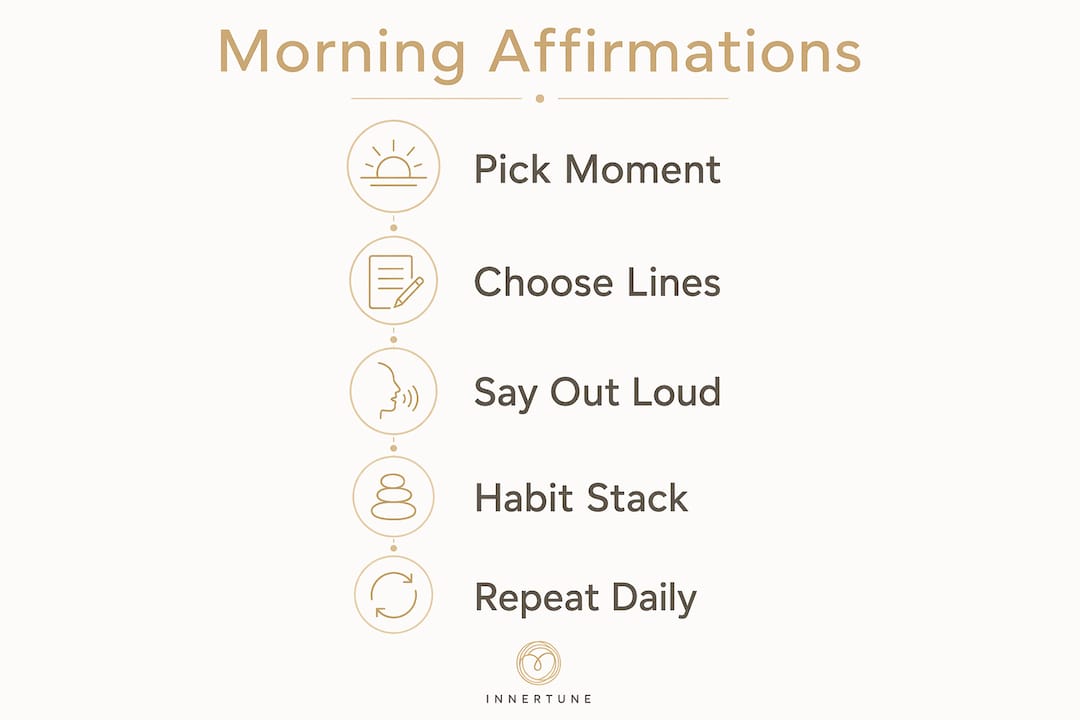
- How to use morning affirmations in three simple steps
- How to write your own morning affirmations that actually stick
- Do affirmations work? Quick science, expert tips, and safety notes
- Three under-60-second morning scripts you can say verbatim
- Key Takeaways
- Why tiny lines are the ones that actually change your morning
- Innertune makes the daily habit easier to keep
- Useful sources and further reading
1. Morning affirmations organized by goal
The most useful affirmations are the ones that match what you actually need that morning. Pick a category, grab three lines, and go.
Confidence
Use these when you need to walk into a room, a meeting, or a hard conversation feeling grounded.
- I trust myself to figure this out.
- I belong in every room I enter.
- My voice matters and deserves to be heard.
- I am confident, calm, and prepared.
- I have handled hard things before, and I can do it again.
- I believe in my ability to grow.
- I show up as my full self today.
- I am more than enough.
- Confidence comes naturally to me.
- I am proud of who I am becoming.
Self-love
Use these on mornings when your inner critic is loud.
- I am worthy of love and kindness.
- I treat myself with the same care I give others.
- I accept myself exactly as I am right now.
- I am enough, just as I am.
- I deserve rest, joy, and peace.
- I forgive myself for past mistakes.
- I am learning to love myself more each day.
- My worth is not tied to my productivity.
- I am gentle with myself when things are hard.
- I celebrate my small wins.
Gratitude
Use these to shift your focus before the noise of the day starts.
- I am grateful for this new day.
- Good things are already in my life.
- I notice and appreciate the small moments.
- I am thankful for my health, my home, and the people I love.
- Today I choose to focus on what is going right.
- I find beauty in ordinary things.
- I am grateful for my ability to grow and change.
- Abundance surrounds me in many forms.
- I appreciate the lessons in every experience.
- I am lucky to be alive and present today.
Abundance and money
Use these when you want to shift your relationship with money and opportunity.
- I am open to receiving abundance in all forms.
- Money flows to me through multiple channels.
- I am worthy of financial success.
- I make smart, confident decisions with my money.
- Opportunities come to me easily and often.
- I am building wealth steadily and intentionally.
- I attract prosperity by doing work I believe in.
- I am financially free and growing.
- I deserve to earn well for the value I provide.
- My relationship with money is healthy and positive.
Energy and motivation
Use these on sluggish mornings when you need momentum.
- I wake up ready to create something good today.
- My energy grows as the day moves forward.
- I am motivated by purpose, not pressure.
- I take one step at a time and keep moving.
- I have everything I need to start right now.
- I am driven, focused, and alive.
- Today I do the things that matter most.
- I choose action over hesitation.
- I bring energy and enthusiasm to everything I do.
- I am unstoppable when I commit to my goals.
Calm and anxiety relief
Use these when your mind is racing or you feel anxious before the day begins.
- I breathe in calm and breathe out tension.
- I am safe right now, in this moment.
- I release what I cannot control.
- My mind is quiet and my body is at ease.
- I trust that things will work out.
- I handle challenges with grace and patience.
- I am grounded, steady, and present.
- I choose peace over worry.
- I am allowed to slow down.
- Each breath I take brings me back to center.
Productivity
Use these when you need focus and follow-through.
- I complete what I start.
- I prioritize what matters and let go of the rest.
- I work with focus and intention.
- I am organized, clear-headed, and effective.
- I make progress every single day.
- I do hard things with a steady mind.
- I am disciplined and consistent.
- I create results by showing up fully.
- I manage my time with purpose.
- Today I move toward my most important goal.
| Category | Best moment to use | Tone |
|---|---|---|
| Confidence | Before a meeting, interview, or social event | Bold, assertive |
| Self-love | When your inner critic is active | Gentle, accepting |
| Gratitude | First thing after waking | Warm, open |
| Abundance | When money stress is present | Expansive, calm |
| Energy | Sluggish or low-motivation mornings | Energizing, direct |
| Calm | Anxious or overwhelmed mornings | Slow, grounding |
| Productivity | Before a heavy workday | Focused, decisive |
How to use morning affirmations in three simple steps
A routine you will actually stick with needs to be short, specific, and attached to something you already do.
Step 1: Pick your moment. The most effective window is within the first ten minutes after waking, before your phone and the news pull your attention elsewhere. Your brain is in a relaxed, receptive state right after sleep, which makes it easier for new thoughts to land. Two to three minutes is enough.

Step 2: Choose three lines and say them out loud. Reading silently works, but speaking aloud adds a layer of physical reinforcement. Stand in front of a mirror if you can, or simply sit upright in bed. Say each line slowly, pause, and let it settle. Repeat each one three times before moving to the next.
Step 3: Habit stack. Pair your affirmations with something you already do every morning, like brewing coffee, brushing your teeth, or stepping into the shower. Habit stacking removes the need for willpower because the existing habit becomes the trigger. After a few days, the affirmations start to feel automatic.
If you want a more intensive approach, the 369 method structures repetition across the whole day: say your affirmation three times in the morning, six times in the afternoon, and nine times in the evening. It is a useful short-term protocol when you are working on a specific intention.
Pro Tip: Set a single phone alarm labeled “3 lines” for the same time each morning. The label itself becomes a cue, and you will not have to remember what to do when it goes off.
How to write your own morning affirmations that actually stick
The lines you write yourself tend to land harder than borrowed ones, because they speak directly to your actual situation.
Start with one of these templates:
- “I am…” (state a quality you want to embody: “I am calm under pressure.”)
- “Today I will…” (name one specific intention: “Today I will speak up in the meeting.”)
- “I am learning to…” (for goals that feel out of reach: “I am learning to trust myself more.”)
- “I allow myself to…” (for permission-giving: “I allow myself to rest without guilt.”)
The before/after shift is where most people get stuck. A vague or negative thought becomes a usable affirmation when you flip the direction and make it present tense:
- Before: “I always mess things up.” → After: “I learn and improve from every experience.”
- Before: “I’m not confident enough.” → After: “I am building confidence every day.”
- Before: “I never have enough money.” → After: “I am creating more financial stability in my life.”
- Before: “Nobody listens to me.” → After: “My ideas are worth sharing and people value what I say.”
Pro Tip: If an affirmation feels false when you say it, add “yet” or a growth phrase. “I am confident” might feel like a lie on a bad day. “I am learning to feel more confident” does not. That small shift keeps the statement credible and prevents the cognitive pushback that shuts the practice down.
Pro Tip: Add an emotional anchor. After saying your affirmation, pause and notice one small physical sensation — a breath, a relaxed jaw, a moment of warmth. Connecting the words to a body feeling speeds up the habit loop.
Do affirmations work? Quick science, expert tips, and safety notes
The short answer: yes, with realistic expectations.
Research on self-affirmation shows that affirming core personal values activates reward-related brain regions and can reduce the defensive response to threatening information. The mechanism connects to neuroplasticity, the brain’s ability to form new neural pathways through repeated experience. When you consistently direct attention toward a positive belief, you are, in a small but real way, practicing a new thought pattern. The brain’s negativity bias, its tendency to weight bad experiences more heavily than good ones, makes this kind of deliberate redirection genuinely useful.
Mental-health professionals are generally supportive, with one important caveat. As Cleveland Clinic notes, positive affirmations can help counter negative self-talk and build a more balanced inner voice. The key is believability. A statement that feels wildly untrue tends to trigger resistance rather than acceptance, which is why the “I am learning to” framing often works better than a flat declaration.
Safety note: Affirmations are a practical tool for everyday mindset work, not a substitute for professional care. If you are dealing with clinical depression, anxiety disorder, trauma, or any condition that significantly affects your daily functioning, please speak with a licensed mental-health professional. Affirmations can complement therapy, but they do not replace it.
| Practice element | Heuristic / guidance |
|---|---|
| Repetition per session | Say each affirmation 3× before moving to the next |
| 369 method (intensive) | 3× morning, 6× afternoon, 9× evening |
| Habit window | Consistent daily practice for several weeks to build a routine |
| Affirmation length | Keep each statement short for easier recall |
| Innertune library | 44,000+ recorded affirmations across dozens of categories |
The science of affirmations is more grounded than the self-help industry sometimes makes it sound. The practice works best when it is consistent, believable, and paired with small real-world actions.
Three under-60-second morning scripts you can say verbatim
These scripts are designed to be spoken, not read. Each one runs about 30–45 seconds at a natural pace.
Motivation script
Use this on mornings when you need to get moving. Take one slow breath before you start.
- “I wake up ready to create something good today.”
- “I am driven by purpose, not pressure.”
- “I take one step at a time and keep moving forward.”
- “Today I do the things that matter most.”
- “I am unstoppable when I commit.”
After the last line, name one specific thing you will do in the next hour. The script sets the tone; the named action makes it real.
Calm script
Use this when anxiety is present. Sit down, close your eyes, and breathe in before each line.
- “I am safe right now, in this moment.”
- “I release what I cannot control.”
- “My mind is quiet and my body is at ease.”
- “I trust that things will work out.”
- “I choose peace over worry.”
Breathe out slowly after the last line. You can repeat the whole script twice if you have an extra minute.
Confidence script
Use this before a presentation, a difficult conversation, or any moment that requires you to show up fully. Stand up straight.
- “I belong in every room I enter.”
- “My voice matters and deserves to be heard.”
- “I have handled hard things before, and I can do it again.”
- “I am confident, calm, and prepared.”
- “I show up as my full self today.”
Speaking these out loud works better than reading them silently, especially for the confidence script. The physical act of projecting your voice reinforces the message in a way that silent reading does not.
Key Takeaways

Morning affirmations work best when they are short, believable, spoken out loud, and tied to a consistent daily trigger.
| Point | Details |
|---|---|
| Start with three lines | Pick one category, choose three affirmations, and say each one three times after waking. |
| Habit stack for consistency | Pair affirmations with an existing morning action (coffee, brushing teeth) to remove reliance on willpower. |
| Write your own with “yet” | If a line feels false, add “I am learning to…” or “yet” to keep it credible and effective. |
| Try it for several weeks | Practical guides cite a few weeks as a useful heuristic for building a consistent routine. |
| Innertune for guided practice | Innertune’s affirmation library offers 44,000+ recorded lines with personalized playlists and background audio to support daily habit-building. |
Why tiny lines are the ones that actually change your morning
There is a version of this practice that looks impressive on paper: a ten-minute journaling ritual, a full mirror session, a carefully curated list of twenty affirmations. Most people do it for three days and quit.
The version that actually works is embarrassingly small. One line. Said once, clearly, before you pick up your phone. That is it. The reason tiny works is not motivational; it is mechanical. A small action has almost no friction, so it survives the mornings when you are tired, rushed, or skeptical. And consistency, not intensity, is what creates the shift.
What I have noticed, both in the research and in how people describe the practice, is that the affirmation itself matters less than the moment of deliberate choice it represents. You are choosing, for about fifteen seconds, to direct your attention toward something true and useful about yourself instead of defaulting to the mental noise that usually fills that space. Over time, that choice gets easier. The thought pattern becomes more available. That is neuroplasticity in its most ordinary, accessible form.
One more thing worth saying: affirmations are words, and words without action stay words. The most effective morning practice pairs a line with a small, concrete next step. “I am focused and effective today” lands differently when you follow it by writing down your one most important task. The affirmation primes the mindset; the action confirms it.
Innertune makes the daily habit easier to keep
Most people do not struggle to understand affirmations. They struggle to do them consistently. That is the gap Innertune is built to close.
Innertune’s affirmation app gives you access to 44,000+ individually recorded affirmations across dozens of categories, from confidence and self-love to productivity and calm. You can build a personalized playlist in minutes, choose from 20+ voice options, and layer in 130+ background beats so the experience feels like something you actually want to return to each morning. Offline mode means your routine is not dependent on a Wi-Fi connection, and sleep mode lets you run affirmations as you drift off at night.
The routines described in this article, the three-line habit stack, the under-60-second scripts, the goal-specific categories, all map directly onto what Innertune is designed to support. You do not have to remember which lines to say or find the motivation to open a notes app. The playlist is already there.
Browse the full affirmation library to find your starting category, or build your first personalized playlist today.
Useful sources and further reading
These are the sources behind this article, plus a few places to go if you want longer lists, deeper science, or expert commentary.
- Berkeley Well-Being Institute: Morning Affirmations — 97 categorized affirmations with a solid explanation of neuroplasticity and negativity bias; good for readers who want the “why” alongside the list.
- PMC / NIH: Self-affirmation and neural response — The peer-reviewed study behind the self-affirmation and brain-activation claims in this article; worth reading if you want the primary research.
- Cleveland Clinic: Do Positive Affirmations Work? — A clinician-reviewed explainer on how affirmations interact with self-talk and when they are most useful.
- Wondermind: Daily Affirmations — Features commentary from Oludara Adeeyo, LCSW, on believability and the mental-health framing of affirmation practice.
- The Good Trade: 99 Positive Morning Affirmations — A large, well-organized list sorted by theme; useful if you want more lines beyond what is covered here.
- Louise Hay Affirmations — The original categorized affirmation library covering love, health, prosperity, and self-esteem; a foundational reference for the practice.
- Innertune Affirmations Library — Innertune’s full collection of daily affirmations for self-love and mental wellness, organized by category and available in the app.
- How Affirmations Rewire Your Brain — Innertune — Innertune’s science page explaining the mechanisms behind affirmation practice, including repetition, audio reinforcement, and habit formation.
Recommended
- SUCCESS IN YOUR CAREER Affirmations - 151 Free
- Pass Your Driving Test Affirmations - 80 Free
- Become a Life Coach Affirmations - 85 Free
- Balancing Ambition with Contentment Affirmations
